Subterranean termite soil defense establishes an unbroken chemical zone throughout exterior soil margins and interior sub-slab interfaces, protecting vulnerable home framing from the subterranean pathways maintained by…
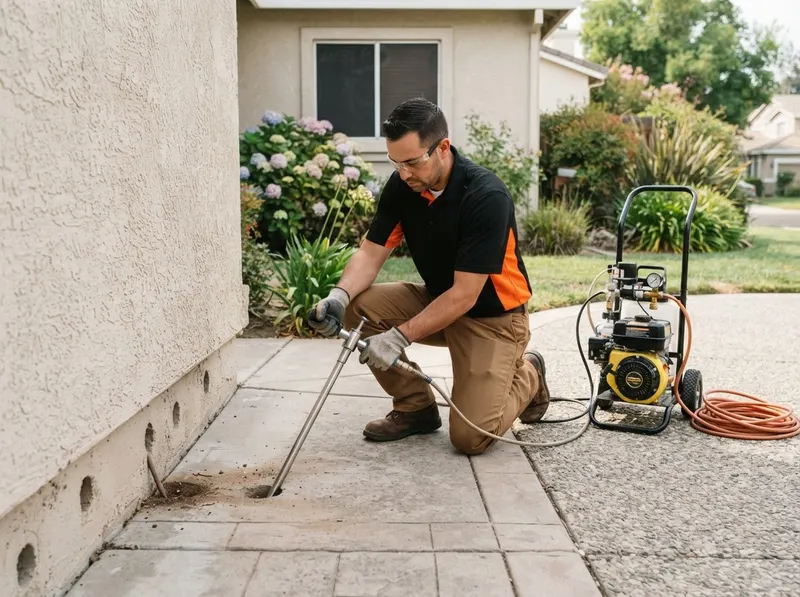
Subterranean termite soil defense establishes an unbroken chemical zone throughout exterior soil margins and interior sub-slab interfaces, protecting vulnerable home framing from the subterranean pathways maintained by UC IPM Pest Notes targets such as Reticulitermes hesperus. Homeowners around Laguna West-Lakeside and Stone Lake encounter heightened subterranean moisture alongside heavy San Joaquin clay soils, which harbor expansive underground colonies seeking seasonal cellulose resources. Unlike drywood treatments that rely on structural fumigation or isolated wood surface coatings, soil defense addresses ground entry directly at foundation contact points. The standard execution requires excavating a 6-inch by 6-inch perimeter trench adjacent to structural stem walls, followed by calibrated pressure rod injection to bond modern non-repellent agents, including fipronil formulations verified under the California Department of Pesticide Regulation guidelines, directly to subsurface strata.
Selecting a subterranean soil barrier over aerial bait station grids depends heavily on structural configuration and soil condition. Concrete slab constructions throughout Madeira and East Elk Grove benefit from continuous chemical soil barriers because subterranean workers exploit hidden slab expansion joints and bath traps beneath finished floor coverings. Bait monitoring matrices require active worker discovery over prolonged periods, whereas a liquid non-repellent zone begins transfer mechanics immediately across colony members as workers unknowingly traverse treated zones according to EPA pesticide standards. The physical trade-off involves ground disruption: exterior landscape gravel or mulch beds along the home's perimeter must be pulled back 8 to 12 inches during treatment, and patio slabs immediately adjoining the exterior foundation require mechanical drilling at 12-inch intervals to inject subterranean barriers below the concrete, which are subsequently resealed with matching masonry plugs.
Properties in Fallbrook, Camden Passage, and rural Sheldon often feature detached garages, decorative porch footings, or expansive grade changes that alter application volume requirements. To ensure safety around pets and young children, applications adhere to label safety practices recognized by the National Pest Management Association, relying on non-volatile, odorless liquid active ingredients that bind tightly to organic matter without off-gassing into interior air ducts. Soil applications do not treat active aerial drywood infestations, nor do they replace plumbing repair when indoor moisture sources draw insects indoors. For comprehensive protection near sensitive riparian corridors like the Laguna Creek Parkway, treatment depths and application volumes follow structural protection mandates established by the Sacramento County Agricultural Commissioner to protect shallow water tables without compromising structural barrier integrity.
1. Initial assessment identifies foundation construction type, crawlspace accessibility, expansion cracks, and perimeter footage across the dwelling.
2. Perimeter trenching opens a 6-inch by 6-inch soil channel around all exterior foundation perimeters to receive chemical binding.
3. Pressure rod injection distributes 4 gallons of finished non-repellent mixture per 10 linear feet into backfilled trench layers.
4. Sub-slab injection drills 1/2-inch access ports through abutting flatwork surfaces, filling the void below before permanent structural sealing.
5. Post-application documentation verifies linear footage coverage, chemical concentration percentages, and scheduled re-inspection periods.
Every job gets a firm, written price after a free on-site visit.
For standards, safe disposal, and service guidance on PEST CONTROL SEVICE in Elk Grove, useful references include U.S. EPA, ENERGY STAR, U.S. Dept. of Energy, Consumer.gov, U.S. Census Bureau, and Google Maps. General consumer and small-business resources are available from USA.gov, Better Business Bureau, FTC Consumer Advice, U.S. Small Business Administration, and Ready.gov.
Tell us about your subterranean termite soil defense job in Elk Grove and we'll send a clear, written quote, usually the same day.
 Reliable Insect Solutions